
Uneven wall thickness in PET preforms: core shift, its causes and what to check on the mould
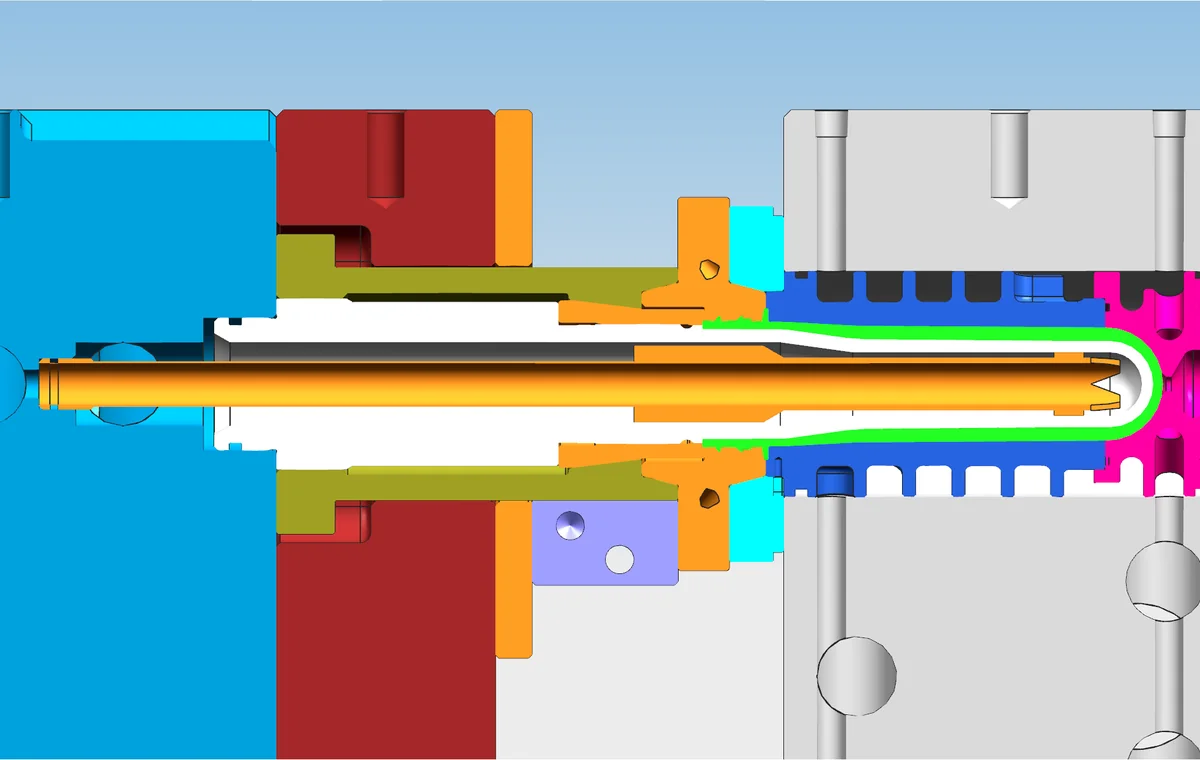
A bottle that is thin on one side, a base that sits off-centre, or a preform that bends slightly after reheating is often blamed on the blow-moulding machine. Sometimes that is where the fault is. It can also already be in the preform, as a wall that is thicker on one side than the other. In a preform mould that pattern is usually called core shift. The measured result is eccentricity, a loss of concentricity.
What core shift means
A preform is formed in the gap between the core, on the inside, and the cavity, on the outside. The neck finish is formed by the neck rings. The core is fixed at its base and is long compared with its diameter, so pressure at the tip can bend it when the locating tapers do not hold the tip in place. Hot PET is injected at high pressure through the gate at the tip. An unbalanced melt front can push the core tip slightly to one side. One side of the gap becomes narrower and the other wider. Melt then tends to flow more readily into the wider side, which can hold the core in the deflected position until the preform freezes.
The result is a preform whose wall is thicker on one side and thinner on the other. The difference may be small. It can still be carried into the bottle.
Why it matters in the bottle
In reheat stretch-blow moulding, the thinner side of a preform can become hotter than the thicker side. The warmer side tends to stretch more, so that side of the bottle can end up thinner still. A column in Plastics Technology on uneven bottle walls calls an off-centre gate in the blow mould the most common cause of this kind of wall variation, and it describes PET's tendency to strain-harden as it stretches, which can offset a small difference. A modest variation does not always become a rejected bottle.
The same column notes that, in two-stage reheat stretch-blow moulding, a preform whose wall varies by more than about 0.004 in (roughly 0.1 mm) can heat unevenly. The thinner side gets hotter and may shrink more after it leaves the oven, so the preform can bend before it reaches the blow mould and the stretch rod meets it off-centre.
Typical signs in the bottle:
- One side of the bottle wall thinner than the other, sometimes enough to fail a top-load or burst test on that side.
- The base and the gate point sitting off-centre.
- The problem following specific cavities of the preform mould, rather than appearing at random.
That last point is the useful clue. If the defect keeps coming from the same cavity numbers, check the preform mould before changing the blow moulder again.
How to confirm it
- Sort preforms by cavity number. Many preform moulds mark the cavity number on the preform. If a preform has no cavity mark, mark the take-out positions before the shot is mixed. Check several shots from each suspect cavity, not a random handful.
- Measure wall thickness around the circumference, at several heights along the body, with a wall-thickness gauge or by sectioning. Record the thickest and thinnest point at each height.
- Compare cavities. If a few cavities stand out, the cause is probably local to those cavities. If every cavity shows the same direction of shift, look at something common to all of them, such as the process settings or the alignment of the whole mould.
- Check weight per cavity at the same time. A cavity that is both off-centre and off-weight is a reason to check the hot runner and the gate on that cavity, as well as the core.
Where to look on the mould
Locating tapers and taper locks
Tapered locating surfaces centre the core, the cavity and the neck ring on each other. The taper lock is the seated fit that is supposed to stop the core tip moving sideways under injection pressure. Neck-ring tapers locate the core at the neck. Wear, damage, dirt, or a taper that is not fully seated can let the core move. Inspect and clean these surfaces, and compare a suspect cavity with a good one.
Neck rings
The neck-ring halves open and close every cycle and also help locate the core at the neck. Worn tapers or guides can let the core tilt. A stuck preform can damage a neck ring, so a cavity that went eccentric after a crash or a jam is worth checking. If spare neck rings from the original trial are still on hand, fitting one is a direct test.
Gate and nozzle alignment
If the hot runner nozzle or the gate insert is not centred on the cavity, the melt can enter off-axis and push the core sideways from the start of filling. A worn or damaged nozzle tip can do something similar. Gate condition also affects stringing and crystallinity.
PET preform gate stringing and crystallinity
Cooling
Core and cavity cooling should be even around the circumference. A scaled or partly blocked circuit lets that part of the mould run hotter. Uneven cooling along a core can bow the core through thermal expansion, and it also changes how the preform freezes. Check water flow and temperature on each circuit, and flush or descale where the flow has dropped. Steel and cooling design are covered in the steel and cycle-time guide.
PET preform mould steel, cooling and cycle time
Interchangeable parts
Where cores, cavities and neck rings are meant to be interchangeable, swapping a suspect core or neck ring into a good position, and the reverse, is a direct way to see which part carries the fault.
Process settings that make it worse
The mould decides how well the core is supported. The process decides how hard the melt pushes it.
- Injection speed and pressure above what the cavity needs to fill can raise the side force on the core while the melt is moving.
- A temperature difference between hot-runner zones or nozzles can change how evenly the cavities fill. Weight that drifts from cavity to cavity is the usual sign. Flow that enters one gate off centre, or heavier on one side of that gate, can push that core sideways.
- Melt viscosity changes with IV, and with resin that was not dried to the grade. A different viscosity can make an existing fill imbalance easier to see. Wet resin is its own defect. It is not evidence that the core has moved.
Changing settings can mask a mild mould problem. Worn tapers and a misaligned nozzle stay out of place until those parts are repaired. If the same cavities keep showing the shift, repair the mould.
What to ask for when buying a new mould
It is easier to agree how the core is located before the mould is built than to correct a poor fit after the mould is in production. When you request a quotation, ask the mould maker:
- How the core, cavity and neck ring are located, and how the taper lock holds the core under injection pressure.
- Whether cores, cavities and neck rings are interchangeable between cavities, and how that interchange is checked.
- Whether the trial report records wall thickness and concentricity for each cavity, not only preform weight.
These points belong on the acceptance checklist and in the quotation request, so every supplier quotes and tests the same items.
Talk to us
OSLON Precision Mold designs and makes PET preform moulds, cap moulds and hot runners at its factory in Taizhou, China. If you have preforms with uneven walls, or you are planning a new mould, bring sample preforms or drawings to Plastics & Rubber Indonesia 2026, booth A3-3026, 17–20 November, JIExpo Kemayoran, Jakarta. You can also send them to frank@oslonmold.com.
Plastics & Rubber Indonesia 2026, booth A3-3026, 17–20 November, JIExpo Kemayoran, Jakarta