
How to request a PET preform mould quotation: what a mould maker needs from you
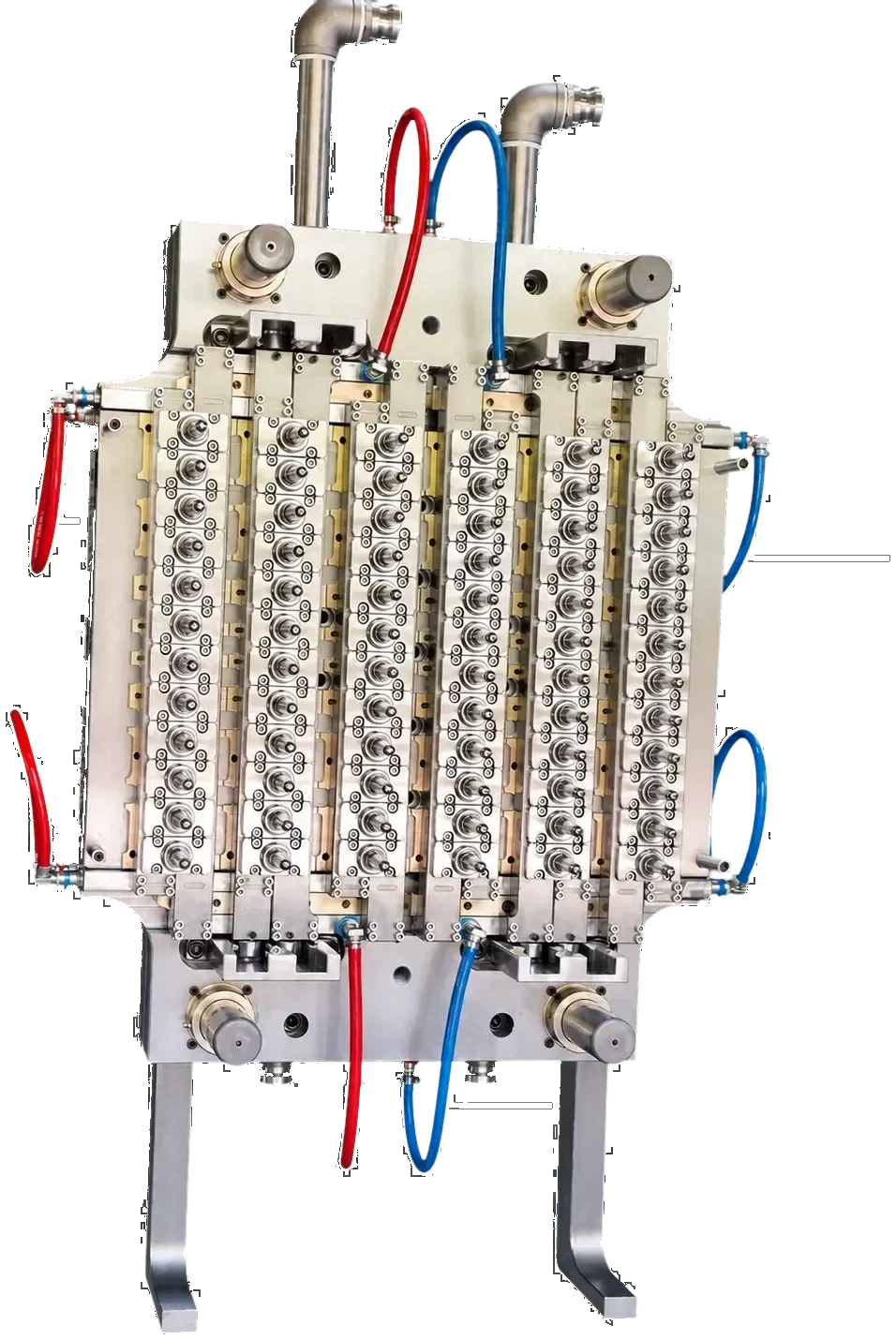
"How much for a 32-cavity preform mould?" is a common first message to a mould maker. It is a fair question, but on its own it cannot be answered well. Two quotes for "32 cavities" can describe very different moulds: different steel, a different hot runner, a different machine fit, a different scope of spare parts. If the request is vague, the quotes you get back are hard to compare, and the real differences only appear after the order. A clear request saves time on both sides and gives you quotes that line up.
The preform itself
The preform drawing is the most important document. If you have one, send it. If you do not, send at least:
- Preform weight in grams, and the acceptable tolerance.
- Neck finish, named by standard (for example PCO 1881, PCO 1810, 29/25, 38 mm), or the cap and closure you will use.
- Preform length below the support ring, and the body outer diameter if it is fixed.
- Bottle volume and bottle drawing, or the blow-moulding machine model, so the preform can be checked against the bottle you actually want to blow.
- Application: still water, carbonated drink, hot-fill, edible oil and so on. This affects wall design and, for some uses, how much attention goes to acetaldehyde or gate quality.
The differences between two common 28 mm finishes are covered in the neck-finish guide.
PCO 1881 vs PCO 1810 neck finish
If only the bottle exists and the preform is still to be designed, say so. Preform design is a separate step and should be agreed before the mould is quoted as final.
Production target
Cavity count should follow from output, not the other way round. Tell the mould maker:
- How many preforms you need per day, month or year.
- How many shifts and days per week the line runs.
- Whether you plan more than one preform weight or neck on the same machine.
From that, the cavity count can be discussed against your machine and budget. The trade-offs are explained in the cavity-count guide. The cavity calculator is only a first screen. It does not replace an engineering match of the mould to the machine. Clamp force, tie-bar distance, closed mould height, daylight and PET shot weight still have to be checked before a cavity count is fixed.
Your injection machine
A mould that does not fit the machine is not a mould you can use. Send:
- Machine brand and model.
- Clamp force, tie-bar distance and platen size.
- Closed mould height: the minimum and maximum stack thickness the clamp accepts.
- Maximum daylight, and the opening stroke if the catalogue lists it separately.
- Shot weight in PET. If the only published figure is a polystyrene (PS) shot weight, label it as PS.
- Ejector type and stroke.
- Robot or post-mould cooling system, if any, and how preforms are taken out.
- Hot runner controller you already have, if you want to keep it, including the number of zones and the connector type.
Closed mould height and daylight are not the same measurement. Closed mould height is the stack thickness when the mould is shut, and the machine has a minimum and a maximum it can clamp. Daylight is the largest distance between the platens when the clamp is fully open. The opening has to clear the closed mould, the preform and the take-out.
State the shot as PET weight. A polystyrene (PS) catalogue shot weight is not the PET shot, and any conversion has to be confirmed for this resin and this screw. Screw diameter alone does not state how much PET the machine can inject.
If the machine is not bought yet, say that too. The mould and machine can then be matched together.
Resin and processing conditions
- PET grade and supplier, and its intrinsic viscosity (IV) if you know it.
- Whether you use recycled PET, and roughly what share.
- Colour or masterbatch, if any.
- Chilled water temperature and capacity available at the machine.
These affect cooling, gate design and cycle time. Cooling and steel choices are covered in the steel and cycle-time guide. None of these figures, on their own, is a promised cycle.
Mould specification to fix in the quote
If you have preferences, write them down so every supplier quotes the same thing:
- Hot runner: open gate or valve gate, and whether you want a specific brand of heaters, thermocouples or controller.
- Steel for core, cavity and neck rings, and the hardness you expect.
- Interchangeability: whether cores, cavities and neck rings must be interchangeable between cavities.
- Spare parts: which spares and how many are included in the price.
- Documents: 2D and 3D drawings, the spare parts list, and the trial report.
Open gate and valve gate are compared in the hot-runner guide. If you have no fixed preference, ask each supplier to state what they propose for each item. That way you can compare, not guess.
Trial, acceptance and delivery terms
Price is only part of the quotation. Ask that the quote states:
- Where and how the mould is trialled, with whose resin, and what is measured (weight per cavity, gate quality, dimensions, cycle time).
- What the acceptance criteria are, and how the trial is reported to you.
- The delivery time, and which event it is counted from (deposit, drawing approval or sample approval).
- Incoterm, packing and destination port.
- Installation or commissioning support, and the warranty terms.
The acceptance checklist lists the usual points to look for in that trial report. Asking for these terms does not set them. The quotation has to state each one.
A short request template
You can copy this into an email and fill it in. The machine rows are separate on purpose: closed mould height, daylight and PET shot weight are three different figures.
| Item | Your answer |
|---|---|
| Preform drawing attached? | Yes / No |
| Preform weight and tolerance | Fill in |
| Neck finish / closure | Fill in |
| Bottle volume and application | Fill in |
| Required output (per day or year) | Fill in |
| Injection machine brand and model | Fill in |
| Closed mould height range (stack thickness) | Fill in |
| Maximum daylight and opening stroke | Fill in |
| PET shot weight, or PS catalogue figure to confirm | Fill in |
| Hot runner: open gate / valve gate / no preference | Fill in |
| Resin grade, IV, rPET share | Fill in |
| Spare parts required | Fill in |
| Trial with your resin? | Yes / No |
| Destination port and Incoterm | Fill in |
A complete request does not lock you into anything. It just means the quotes you receive describe the same mould, so you can compare price against what is really included.
Bring it to Jakarta
OSLON Precision Mold designs and makes PET preform moulds, cap moulds and hot runners at its factory in Taizhou, China. If you are planning a new preform mould, bring your preform or bottle drawing and machine details to Plastics & Rubber Indonesia 2026, booth A3-3026, 17–20 November, JIExpo Kemayoran, Jakarta. We can go through the specification with you. You can also send them to frank@oslonmold.com.
Plastics & Rubber Indonesia 2026, booth A3-3026, 17–20 November, JIExpo Kemayoran, Jakarta
Questions buyers ask
Is mould height the same thing as daylight?
No. Closed mould height and daylight are not the same measurement. Closed mould height is the stack thickness when the mould is shut, and the machine has a minimum and a maximum it can clamp. Daylight is the largest distance between the platens when the clamp is fully open. The opening has to clear the closed mould, the preform and the take-out.
Can screw diameter stand in for the shot weight?
No. State the shot as PET weight. A polystyrene (PS) catalogue shot weight is not the PET shot, and any conversion has to be confirmed for this resin and this screw. Screw diameter alone does not state how much PET the machine can inject.
Does the cavity calculator fix the cavity count?
No. The cavity calculator is only a first screen. It does not replace an engineering match of the mould to the machine. Clamp force, tie-bar distance, closed mould height, daylight and PET shot weight still have to be checked before a cavity count is fixed.